Quantum computers are going to be the next computing champion, and all compute currently working on classical architectures will eventually transition to quantum computing.
There have been several instances where research on quantum computers leads to the same conclusion: quantum computers are not really helpful for all kinds of situations — they are only useful in specific conditions where the problems are very narrow. But this is not entirely true, and it will change over time. Here are two reasons why:
First, the assumption that only a small segment of traditional problems can benefit from quantum computing breaks down with the rising multi-dimensionality of data. The problems of tomorrow are growing in dimensions, and increasingly, every problem — even today — is being reframed through the lens of artificial intelligence. This AI-centric reframing of problems is the key driver for the growing importance of quantum computers.
Second, the AI revolution has barely started leveraging quantum computers. We have not unlocked that potential, and we are at the cusp of reaching the end of Moore's Law. Classical semiconductor scaling, which drove exponential growth for over five decades, is approaching fundamental physical limits — quantum tunneling, leakage currents, and soaring fabrication costs are making further transistor shrinkage increasingly impractical [1]. Even Gordon Moore himself predicted between 2012–2016 that Moore's Law would end by around 2025 [2]. We have already passed the era of slow, steady gains and are now at the peak of accelerated computing driven by NVIDIA's GPU revolution. From this point, two constraints emerge that classical compute cannot satisfy: the energy problem and the widening gap between market demand and supply. AI demand for compute is growing by the day, and that demand will ultimately be fulfilled by quantum computers.
Claim 1: All Problems Are Being Reframed Through the Lens of AI
This is already evident with multiple AI companies emerging and increasing productivity by multiple folds. Big tech firms like Google, Meta, Microsoft, Amazon, Apple, and OpenAI plan to spend over $300 billion in 2025 alone on new AI data centers, with total AI datacenter spending estimated at $475 billion — up 42% from 2024 [3]. Every industry from finance to drug discovery is recasting its core challenges as AI problems, and AI problems are fundamentally compute problems.
Claim 2: Quantum Computers Can Solve AI Problems Exponentially Faster
You have likely heard that a quantum computer works differently from a classical computer — it uses qubits that can exist in a state of 1, 0, or both simultaneously through superposition. But what does that actually mean in practice?
Consider a matrix [1, 2], [2, 3]. Whether you multiply matrices sequentially on a CPU or in parallel via GPU acceleration, the operations must still be carried out through physical semiconductor transistors, FETs, and registers to solve the equation.
Most of the time spent in large AI model training — and within training, most of the time — is consumed by matrix multiplication, with additional overhead for cost function evaluation. Some will argue quantum computers don't have a proven speedup for dense matrix multiplication specifically. The point here is broader: as AI models scale to trillions of parameters, the quantum advantage extends beyond raw matmul to quantum kernel methods, quantum sampling, and variational quantum algorithms that can explore solution spaces classical hardware simply cannot traverse.
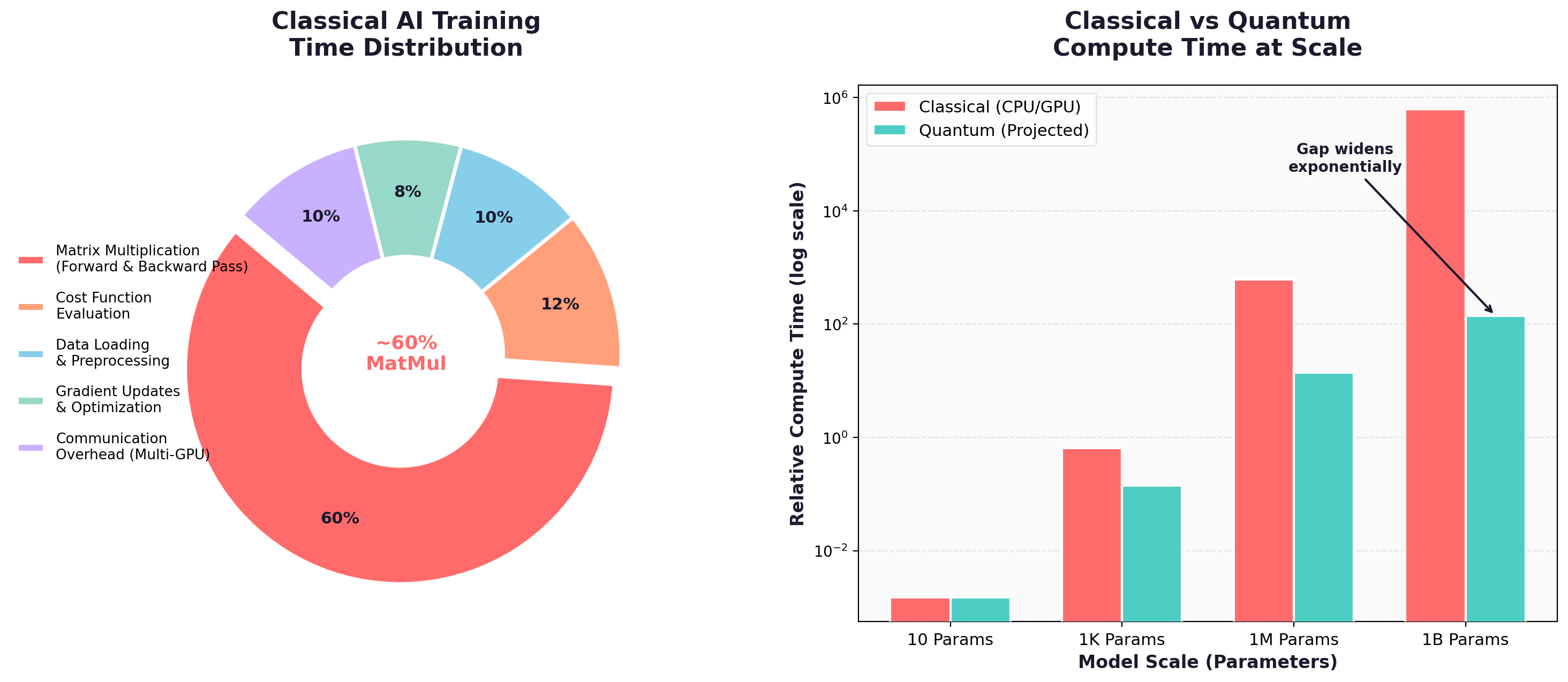
For an example problem with 10 parameters, the compute is manageable. Scale that to a million parameters, and there is a massive difference in feasibility for classical semiconductors due to energy constraints and the sheer scale of operations required.
For quantum operations, the same mathematical operation is performed but measured differently:
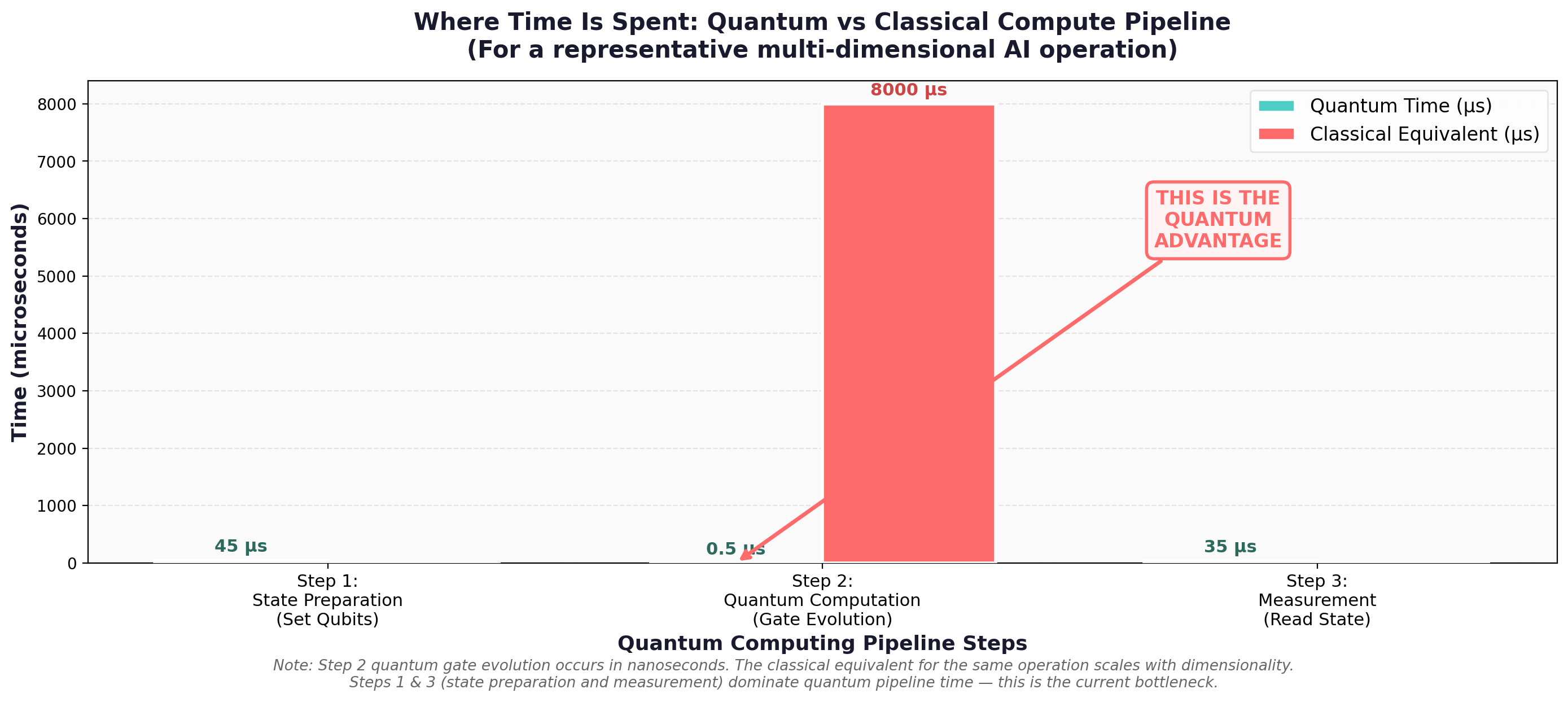
- Set the state: Waveguides tune for resonance; the quantum chip establishes the qubit state to represent the amplitude of the tensor multiplication.
- Compute: The quantum state itself evolves almost instantaneously (relative to classical computation — quantum gates operate in nanoseconds vs. the millions of sequential clock cycles classical processors need for equivalent high-dimensional operations) — this is where all the benefit of quantum computers lies.
- Measure: Read the state before it collapses.
As we encounter more multi-dimensional data requiring billions or even trillions of matrix multiplications, these calculations can be performed nearly instantaneously (orders of magnitude faster than classical, not literally zero-time — the advantage is exponential speedup through superposition and entanglement, not infinite speed) with a fraction of the power required by classical computers. AI would no longer be an energy problem. Critics will point out that quantum cooling systems themselves are energy-intensive. True — today. But the energy cost of cooling a quantum processor that replaces thousands of GPU-hours is a net gain at scale, and room-temperature quantum approaches are an active area of research. Recent research confirms this trajectory: quantum-enhanced AI approaches show potential to outperform purely classical techniques, particularly in computationally intensive tasks, with hybrid quantum-classical architectures serving as pre-processing units for classical AI inference [4].
Most of the total time (which is still less net time compared to classical computers) is spent on steps 1 and 3 — setting the qubit state and measuring it.
Major Bottlenecks
Bottleneck 1: Noise
The slightest noise can disrupt the quantum state. We currently need overwhelmingly complex cooling systems and huge machinery to maintain near-zero Kelvin temperatures. However, Google's Willow chip (December 2024) achieved a historic breakthrough: for the first time, increasing the number of qubits actually reduced error rates exponentially — a 30-year goal known as "below threshold" quantum error correction. Willow's 105-qubit processor performed a benchmark computation in under five minutes that would take today's fastest supercomputer 10 septillion (10²⁵) years [5]. In November 2025, Quantinuum launched Helios, the world's most accurate commercial quantum computer with 98 physical qubits at 99.921% two-qubit gate fidelity, already being used by JPMorgan Chase, Amgen, and BMW for commercially relevant research [6].
Bottleneck 2: Classical I/O Dependency
Quantum computers cannot directly run input and output in the digital sense we have today. The current data path looks like:
- Traditional: Analog → ADC → CPU → DAC → Output
- Current Quantum: Analog → ADC → CPU → DAC → Analog (waveguide) → Quantum Processor → Analog (waveguide) → ADC → CPU → DAC (Display)
- Future Quantum: Analog → AQC (Analog-to-Quantum Converter) → Quantum Processor → QAC (Quantum-to-Analog Converter) → Output
Note: AQC/QAC are conceptual terms coined here to describe the missing link — direct analog-to-quantum transduction without classical intermediaries. This is not established terminology yet, because the technology itself doesn't exist yet. That's precisely the bottleneck and the opportunity.
Multi-Dimensionality of Data Is Increasing Day by Day
Stock markets now process thousands of correlated instruments across global exchanges in real-time, each with dozens of features — price, volume, sentiment, macroeconomic indicators, options Greeks — creating truly high-dimensional optimization landscapes. Genomics and drug discovery involve molecular simulations with millions of interacting variables. Autonomous systems fuse LiDAR, camera, radar, and sensor data into multi-dimensional tensors for real-time decision-making. Climate modeling integrates atmospheric, oceanic, and terrestrial variables across spatial and temporal dimensions. The sheer number of companies, data sources, and parameters is only increasing.
A Note on History and Philosophy
Historically, there are broadly two schools of thought in building complex systems:
- Assembly and supply chain integration: Achieving perfect balance by bringing components together from specialized suppliers — like the pencil example, Windows, or hybrid cars.
- Vertically integrated, lean-quality products: Companies like Apple, Tesla, and Google that own the entire stack from hardware to software.
For quantum computers, the prevailing consensus is that full integration is not possible — that quantum must work in combination with traditional classical computers. And right now, they are right.
Until some startup, company, or breakthrough solution manifests and solves the bottlenecks outlined above: an easier mechanism to establish a stable quantum state and making AQC/QAC conversion possible. IBM is already working toward the world's first quantum-centric supercomputer integrating quantum processors with classical CPUs and GPUs [7], and quantum computing companies raised $3.77 billion in equity funding during just the first nine months of 2025 — nearly triple the $1.3 billion raised in all of 2024 [8].
The value of what this will save in the future is immense.
Who's Already Building This Future
The worldview I've outlined here — quantum as the inevitable successor for compute-intensive AI workloads, vertical integration as the path forward, and the end of Moore's Law as the forcing function — is not just my thesis. Several leading companies and divisions are actively betting on this exact trajectory:
Google Quantum AI (led by Hartmut Neven) is perhaps the strongest proponent. Neven's Law — that quantum computing power grows at a doubly exponential rate — directly supports the argument that quantum will outpace classical scaling. His team delivered Willow and has stated they expect real-world commercial quantum applications within five years [9]. Neven founded the Quantum AI Lab in 2012 specifically to accelerate machine intelligence through quantum processors.
Quantinuum (led by CEO Rajeeb Hazra) declared at Helios's launch: "The next computing inflection point starts today." Their partnership with NVIDIA to integrate GB200 GPUs with Helios via NVQLink is the hybrid quantum-classical bridge this blog describes — and their GenQAI (Generative Quantum AI) framework achieved a 234x speedup in generating training data for pharmaceutical molecules [6].
IonQ (CEO Peter Chapman) just announced the acquisition of SkyWater Technology for $1.8B in January 2026, creating the first vertically integrated full-stack quantum platform company — exactly the kind of move from "assembly" to "vertical integration" I argue is necessary. They are targeting 200,000 physical qubit QPUs by 2028 [10].
PsiQuantum is pursuing a different but equally bold path — photonic quantum computing manufactured on existing semiconductor fabs at GlobalFoundries, with $1B+ in funding and the goal of building a million-qubit machine [11].
SandboxAQ (spun out of Google/Alphabet, led by Jack Hidary) is building AI+Quantum applications at the intersection I describe, valued at $5.6B, backed by T. Rowe Price and Breyer Capital [12].
IBM Quantum continues executing on its roadmap toward quantum-centric supercomputing with its Kookaburra 4,158-qubit system expected soon, and has already announced plans to integrate quantum processors with classical CPUs/GPUs via middleware [7].
I'd love to hear from practitioners at these organizations and anyone working on the AQC/QAC transduction problem, room-temperature quantum architectures, or quantum machine learning at scale. The bottlenecks I've described are real — but so is the momentum toward solving them.
References
[1] Imec, "Is Moore's Law Dead? Understanding the Challenges and Future of Semiconductor Scaling," imec-int.com
[2] Wikipedia, "Moore's Law," citing forecasters including Gordon Moore predicting the end by ~2025
[3] EE Times, "The Impact of the End of Moore's Law on the AI Gold Rush," September 2025 — citing Gartner estimates
[4] Klusch et al. (2024); Ciliberto et al. (2018), as reviewed in "Quantum computing and artificial intelligence: status and perspectives," arXiv:2505.23860v3, June 2025
[5] Google Research, "Making Quantum Error Correction Work" & Nature paper: "Quantum error correction below the surface code threshold," December 2024
[6] Quantinuum, "Commercial Launch of Helios Quantum Computer," November 2025 — 98 PQ at 99.921% 2-qubit gate fidelity
[7] IBM Quantum Roadmap 2024–2025: Quantum-centric supercomputer integrating quantum processors with classical CPUs/GPUs
[8] SpinQ, "Quantum Computing Industry Trends 2025" — $3.77B equity funding in first 9 months of 2025
[9] Reuters/The Quantum Insider, "Google Quantum AI Head Sees Commercial Quantum Within Five Years," February 2025 — Hartmut Neven
[10] IonQ Press Release, "IonQ to Acquire SkyWater Technology, Creating the Only Vertically Integrated Full-Stack Quantum Platform Company," January 2026
[11] PsiQuantum, Omega photonic chipset announced February 2025, manufactured at GlobalFoundries; $1B+ Series D led by BlackRock
[12] SpinQ/The Quantum Insider, SandboxAQ valued at $5.6B, backed by T. Rowe Price, Breyer Capital and institutional investors